Beware of the email scam known as the “You Pervert, I Recorded You” blackmail scheme—a classic case of fear-based extortion that’s been making rounds in inboxes. These emails claim that your computer was hacked via a remote Trojan, giving the sender full access to your files and camera to record compromising videos. They demand payment, typically $800 in Bitcoin, threatening to share the alleged footage with your contacts and online if you don’t comply.
Here’s the kicker: this scam relies on panic, not proof. The attacker often forges the “from” address to make it look like the email was sent from your own account, adding a layer of intimidation. But in reality, they have no access to your devices or private info—it’s a bluff exploiting fear and shame. The email’s sophisticated-sounding jargon and detailed Bitcoin payment instructions are designed to look convincing, but they’re all part of a psychological trick.
If you get one of these messages, don’t panic or pay a dime. Instead, delete it, change your passwords, and make sure your security software is up-to-date. Remember, these scams exploit emotions to manipulate you into paying—staying calm and informed is your best defense.
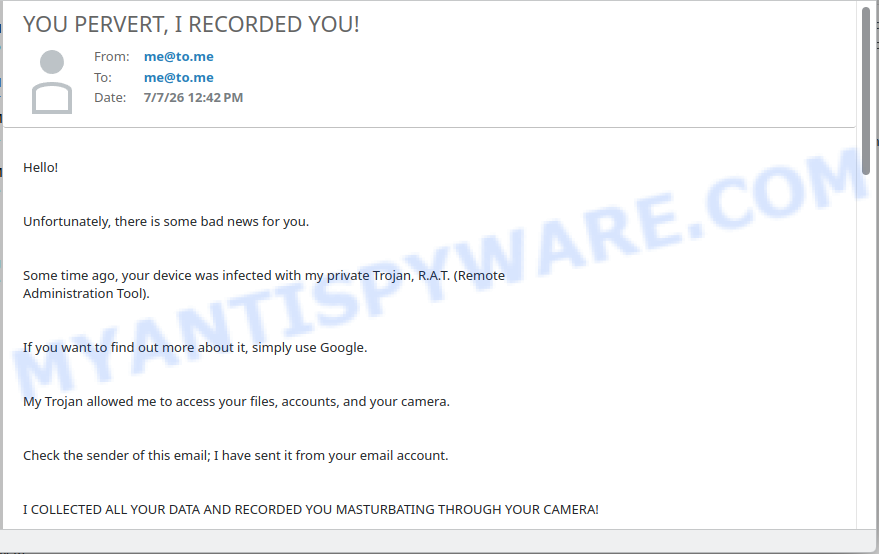
A typical “YOU PERVERT, I RECORDED YOU” scam email reads as follows:
Email Subject:
YOU PERVERT, I RECORDED YOU!Email body:
Hello!Unfortunately, there is some bad news for you.
Some time ago, your device was infected with my private Trojan, R.A.T. (Remote Administration Tool).
If you want to find out more about it, simply use Google.
My Trojan allowed me to access your files, accounts, and your camera.
Check the sender of this email; I have sent it from your email account.
I COLLECTED ALL YOUR DATA AND RECORDED YOU MASTURBATING THROUGH YOUR CAMERA!
If you still doubt my serious intentions, it only takes a couple of mouse clicks to share all your data and the video of you masturbating with your family, friends, relatives, all email contacts, on social networks and the darknet.
After that, I removed my malware to leave no traces.
To ensure you read this email, you will receive it multiple times.
All you need is $800 USD in Bitcoin (BTC), transferred to my wallet address.
After the transaction is successful, I will proceed to delete everything.
You can purchase Bitcoin (BTC) from reputable exchanges here:
hxxp://www.coinbase.com – Payment options: Credit/Debit Cards, Bank Transfers, PayPal (in some regions).
hxxp://www.binance.com – Payment options: Credit/Debit Cards, Bank Transfers, P2P trading, third-party payment providers, and gift cards.
hxxp://www.bitrefill.com – Payment options: Paysafecard, credit/debit cards, crypto, bank transfer, and other gift cards.
hxxp://www.crypto.com – Payment options: Credit/Debit Cards, Bank Transfers, Apple Pay, Google Pay, and more.
hxxp://www.etoro.com – Payment options: Credit/Debit Cards, Bank Transfers, PayPal.Alternatively, simply Google for other exchanges.
Once purchased, you can send the Bitcoin (BTC) directly to my wallet address or use a wallet application such as Atomic Wallet or Exodus Wallet to manage your transactions.
My Bitcoin (BTC) wallet address is: 1Loo6tksj4vV6k5PjxUArfaW8jVgvfazeA
Yes, that’s how the wallet address looks. Copy and paste my wallet address; it’s case-sensitive.
A piece of advice from me: regularly change all your passwords and update your device with the latest security patches.
🕵️♂️ How the “YOU PERVERT, I RECORDED YOU” Scam Operates
“YOU PERVERT, I RECORDED YOU” is a common email blackmail scam targeting unsuspecting users. 🚨 It’s a type of fraud where scammers send threatening emails claiming they have hacked your device and recorded compromising videos, demanding ransom payment in Bitcoin to avoid sharing the alleged footage.
🔗 Step-by-Step Breakdown of the Scam:
📧 Sending Intimidating Emails
Scammers mass-send emails with alarming messages stating your device was infected with malware (a Trojan or Remote Access Tool) that allowed them to spy on you, steal files, and secretly record your webcam.
🕵️♂️ Claiming to Have Sensitive Footage
The email falsely claims the scammer recorded you performing embarrassing acts through your camera and threatens to expose the footage to your contacts, family, friends, and social media.
💰 Demanding Bitcoin Ransom
To scare victims into paying, the scammer demands $800 USD in Bitcoin. The email provides a Bitcoin (BTC) wallet address and instructions on how to buy and send Bitcoin, urging quick payment to avoid consequences.
🔄 Repeated Threat Emails
To increase pressure, the scammer warns they will send the threatening email repeatedly until payment is made, attempting to overwhelm and panic the recipient.
❌ No Real Hacking Involved
These emails are purely scams; no malware or hacking usually took place. The sender often spoofs your own email address to make the email look more credible.
🚫 No Actual Footage or Data Breach
There is no real video or data breach. The threat to distribute compromising content is fabricated to extort money.
In summary, the “YOU PERVERT, I RECORDED YOU” scam exploits fear and embarrassment to extort Bitcoin payments from victims. These emails are fraudulent and based on false claims of hacking and surveillance. Recipients should ignore the threats, avoid paying, and strengthen their cybersecurity practices.
Summary Table
| Name | YOU PERVERT, I RECORDED YOU Email Scam |
| Type | Extortion Email Scam / Sextortion |
| Delivery Method | |
| Scam Characteristics | Claims victim’s device was infected with a Trojan (R.A.T.), alleges recording victim through their camera performing explicit acts, threatens to share private data and videos with contacts and online if ransom is not paid, uses victim’s own email address as sender to add credibility |
| Requested Payment | $800 USD in Bitcoin (BTC) |
| Payment Method | Bitcoin (BTC) sent to a specified Bitcoin wallet address (1Loo6tksj4vV6k5PjxUArfaW8jVgvfazeA) |
| Additional Tactics | Threatens repeated email deliveries to pressure victim, claims malware was removed to remove traces, includes detailed payment instructions and trustworthy cryptocurrency exchange links to appear legitimate |
| Advice / Tips | Do not reply or pay the ransom, do not panic as scammer likely has no recordings, regularly update device software and security patches, change all passwords to strong ones, enable two-factor authentication, verify security of accounts, use antivirus software, report scam attempts to email providers or authorities |
📧 What to Do When You Receive the “YOU PERVERT, I RECORDED YOU” Scam Email
We advise everyone who receives this email to follow the simple steps below to protect yourself from potential scams:
- ❌ Do not believe this email.
- 🔒 NEVER share your personal information and login credentials.
- 📎 Do not open unverified email attachments.
- 🚫 If there’s a link in the scam email, do not click it.
- 🔍 Do not enter your login credentials before examining the URL.
- 📣 Report the scam email to the FTC at www.ftc.gov.
If you accidentally click a phishing link or button in the “YOU PERVERT, I RECORDED YOU” Email, suspect that your computer is infected with malware, or simply want to scan your computer for threats, use one of the free malware removal tools. Additionally, consider taking the following steps:
- 🔑 Change your passwords: Update passwords for your email, banking, and other important accounts.
- 🛡️ Enable two-factor authentication (2FA): Add an extra layer of security to your accounts.
- 📞 Contact your financial institutions: Inform them of any suspicious activity.
- 🔄 Monitor your accounts: Keep an eye on your bank statements and credit reports for any unusual activity.
🔍 How to Spot a Phishing Email
Phishing emails often share common characteristics; they are designed to trick victims into clicking on a phishing link or opening a malicious attachment. By recognizing these signs, you can detect phishing emails and prevent identity theft:
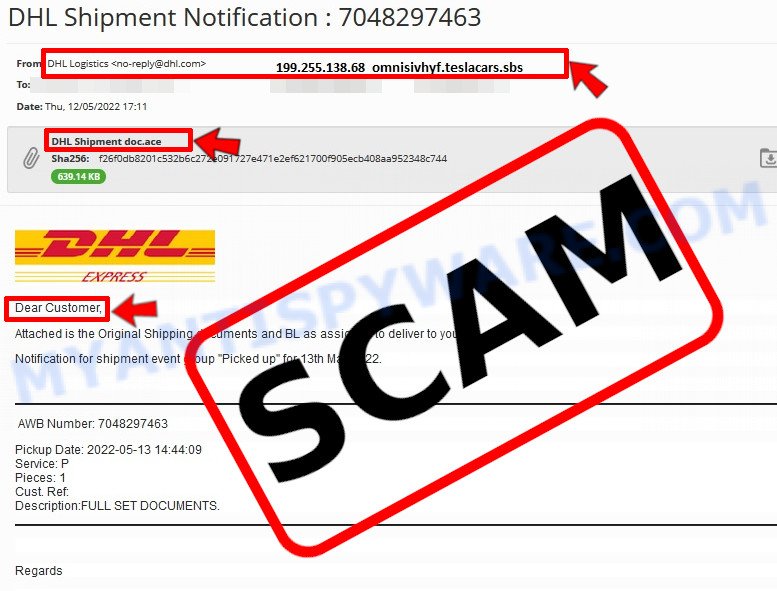
💡 Here Are Some Ways to Recognize a Phishing Email
- ✉️ Inconsistencies in Email Addresses: The most obvious way to spot a scam email is by finding inconsistencies in email addresses and domain names. If the email claims to be from a reputable company, like Amazon or PayPal, but is sent from a public email domain such as “gmail.com”, it’s probably a scam.
- 🔠 Misspelled Domain Names: Look carefully for any subtle misspellings in the domain name, such as “arnazon.com” where the “m” is replaced by “rn,” or “paypa1.com,” where the “l” is replaced by “1.” These are common tricks used by scammers.
- 👋 Generic Greetings: If the email starts with a generic “Dear Customer”, “Dear Sir”, or “Dear Madam”, it may not be from your actual shopping site or bank.
- 🔗 Suspicious Links: If you suspect an email may be a scam, do not click on any links. Instead, hover over the link without clicking to see the actual URL in a small popup. This works for both image links and text links.
- 📎 Unexpected Attachments: Email attachments should always be verified before opening. Scan any attachments for viruses, especially if they have unfamiliar extensions or are commonly associated with malware (e.g., .zip, .exe, .scr).
- ⏰ Sense of Urgency: Creating a false sense of urgency is a common tactic in phishing emails. Be wary of emails that claim you must act immediately by calling, opening an attachment, or clicking a link.
- 📝 Spelling and Grammar Errors: Many phishing emails contain spelling mistakes or grammatical errors. Professional companies usually proofread their communications carefully.
- 🔒 Requests for Sensitive Information: Legitimate organizations typically do not ask for sensitive information (like passwords or Social Security numbers) via email.
Conclusion
The “YOU PERVERT, I RECORDED YOU” email is a fraudulent extortion attempt designed to frighten and coerce recipients into sending Bitcoin payments. This scam relies on scare tactics, such as false claims of device infection with spyware and alleged compromising video recordings, none of which are true.
The scammers behind this email use generic threats and widely known fear-mongering language to intimidate potential victims into compliance. They even pretend to send the message from your own email account to lend false credibility. The listed instructions about cryptocurrency purchases and wallet addresses are simply intended as a vehicle for anonymous payments beyond law enforcement reach.
Bottom Line: Ignore any emails threatening you with invasion of privacy or demanding cryptocurrency payments, especially those that claim to have no proof or provide no evidence. Do not respond or send money. Instead, take appropriate security measures such as changing all your passwords, enabling two-factor authentication, scanning your devices with reputable antivirus software, and keeping your software up to date.