Scam emails like the one from the so-called “ShinyHunters” hacking group are classic scare tactics designed to trick you into paying money under false pretenses. The core of this scam is a threat: hackers claim they’ve hacked your devices, recorded compromising videos, and will release them unless you pay a ransom — in this case, $2000 in Litecoin.
Here’s the reality: these emails rely on fear and intimidation but almost never have any real proof or actual access to your devices. They exploit common worries about privacy and security, hoping you’ll panic and send payment without verifying their claims. The message is carefully crafted to pressure you — don’t reply, don’t involve authorities, and don’t reset your devices.
At its essence, this scam is all about manipulation through fake urgency and fabricated evidence. Before considering any payment or action, it’s crucial to understand that these threats are usually empty bluffs. Staying calm, not responding, and using reliable security tools are your best defenses. Keep reading to learn how to spot these scams early, protect your devices, and respond safely if you ever get a message like this.
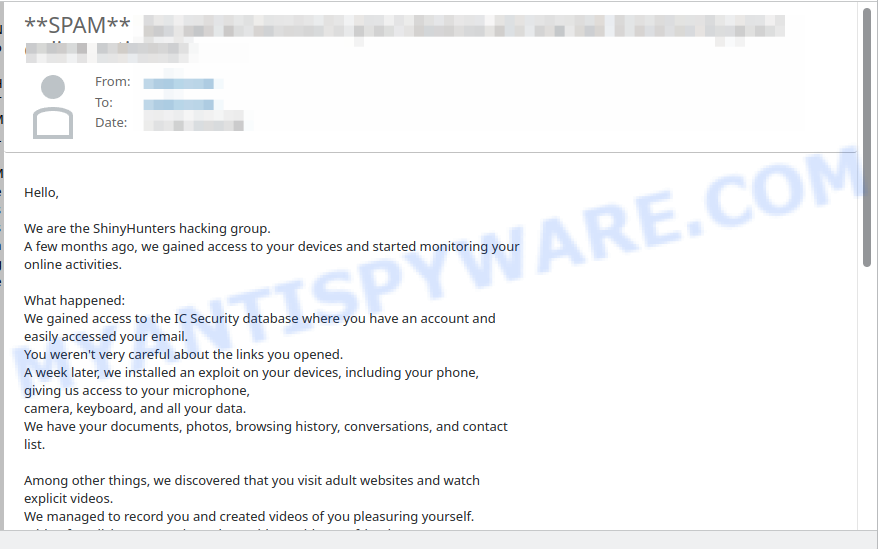
A typical “We are the ShinyHunters hacking group” scam email reads as follows:
Hello,
We are the ShinyHunters hacking group.
A few months ago, we gained access to your devices and started monitoring your online activities.What happened:
We gained access to the IC Security database where you have an account and easily accessed your email.
You weren’t very careful about the links you opened.
A week later, we installed an exploit on your devices, including your phone, giving us access to your microphone,
camera, keyboard, and all your data.
We have your documents, photos, browsing history, conversations, and contact list.Among other things, we discovered that you visit adult websites and watch explicit videos.
We managed to record you and created videos of you pleasuring yourself.
With a few clicks, we can share these videos with your friends,
colleagues, and family or even make them public.Proposal:
Send us $2000 in Litecoin (search online how to buy) to the following wallet:
ltc1qfpjl5999jwpjq7kvyjld9akaspx69qaxvxrf20We’ll delete everything immediately.
You have 48 hours from the moment you open this email.
Once the payment is received, we’ll remove the malware from your devices.
We’ll also remove all your personal information from darkweb for you to be safe from now on.What you should NOT do:
Do not reply (email was sent from a hacked account).
Do not contact the police or anyone else—we’ll release the videos along with other stuff all over the internet.
Do not try to reset your devices—everything is stored on remote servers.What you don’t need to worry about:
We will see your payment immediately—the wallet is generated specifically for you.
We will not share your videos or other things after payment—there is no reason to continue causing problems.You’re not the only one in this situation.
Be smart and cooperate; otherwise, you’re going to regret it.
🕵️♂️ How the ShinyHunters Email Scam Operates
The ShinyHunters Email scam is a form of cyber extortion. 🚨 It involves hackers threatening to release embarrassing personal content unless a ransom is paid. 🔗 Step-by-Step Breakdown of the Scam:
📧 Sending Threatening Emails
The scammers send alarming emails claiming to have hacked your devices and accessed your personal information, including photos, videos, browsing history, and conversations. They often state they recorded compromising videos to intimidate you into paying.
🕵️♂️ Exploiting Fear and Privacy
By exploiting your fear of exposure, they pressure you to pay quickly, often threatening to distribute sensitive content to friends, family, colleagues, or the public if you do not comply.
💰 Demanding Cryptocurrency Ransom
They demand payment — usually in untraceable cryptocurrency like Litecoin — to a specific wallet address, promising to delete all the stolen data once the ransom is received.
⏳ Imposing a Tight Deadline
To escalate urgency, they impose a strict deadline, like 48 hours from when you open the email, increasing stress and limiting your time to seek help or verify the claims.
🚫 Discouraging Reporting or Replying
The scam emails warn you not to respond, contact law enforcement, or reset your devices, falsely claiming these actions will cause immediate harm or release of your data.
🔄 Claiming Payment Guarantees
They often assure you that once payment is made, your data will be deleted and your privacy restored, though there is no guarantee they will honors these claims.
❌ Offering No Real Support
The scammers provide no legitimate way to verify their claims or seek help, and often use hacked email accounts to send threats, making it difficult to trace or block them.
In summary, the ShinyHunters email scam attempts to extort money by falsely claiming they have hacked you, recorded compromising videos, and will share your private information unless you pay a ransom. They use fear, urgency, and fake technical claims to pressure victims into paying cryptocurrency. It is important to remain calm, avoid paying, do not reply to the emails, and report the scam to appropriate authorities or cybersecurity professionals.
Summary Table
| Name | ShinyHunters Email Blackmail Scam |
| Type | Phishing / Sextortion / Extortion Scam |
| Scam Origin | ShinyHunters hacking group (self-claimed) |
| Method | Email threat claiming device compromise and private video recordings |
| Threat Details | Alleged access to victim devices including microphone, camera, keyboard, and data; claim of recorded explicit videos and browsing history |
| Demand | $2000 in Litecoin cryptocurrency paid within 48 hours |
| Cryptocurrency Wallet | ltc1qfpjl5999jwpjq7kvyjld9akaspx69qaxvxrf20 |
| Victim Instructions | Do not reply, do not contact police or reset devices, pay to avoid public exposure |
| Supposed Guarantee | Removal of malware and deletion of personal info from dark web after payment |
| Scam Indicators | Use of fear and urgency, unverifiable claims, extortion via email, cryptocurrency payment demanded |
| Category | Cyber extortion, phishing, sextortion |
| Tips to Avoid | Do not pay ransom, verify device security via trusted IT experts, reset passwords and enable two-factor authentication, report to authorities, do not respond to scam emails |
📧 What to Do When You Receive the “We are the ShinyHunters hacking group” Scam Email
We advise everyone who receives this email to follow the simple steps below to protect yourself from potential scams:
- ❌ Do not believe this email.
- 🔒 NEVER share your personal information and login credentials.
- 📎 Do not open unverified email attachments.
- 🚫 If there’s a link in the scam email, do not click it.
- 🔍 Do not enter your login credentials before examining the URL.
- 📣 Report the scam email to the FTC at www.ftc.gov.
If you accidentally click a phishing link or button in the “We are the ShinyHunters hacking group” Email, suspect that your computer is infected with malware, or simply want to scan your computer for threats, use one of the free malware removal tools. Additionally, consider taking the following steps:
- 🔑 Change your passwords: Update passwords for your email, banking, and other important accounts.
- 🛡️ Enable two-factor authentication (2FA): Add an extra layer of security to your accounts.
- 📞 Contact your financial institutions: Inform them of any suspicious activity.
- 🔄 Monitor your accounts: Keep an eye on your bank statements and credit reports for any unusual activity.
🔍 How to Spot a Phishing Email
Phishing emails often share common characteristics; they are designed to trick victims into clicking on a phishing link or opening a malicious attachment. By recognizing these signs, you can detect phishing emails and prevent identity theft:
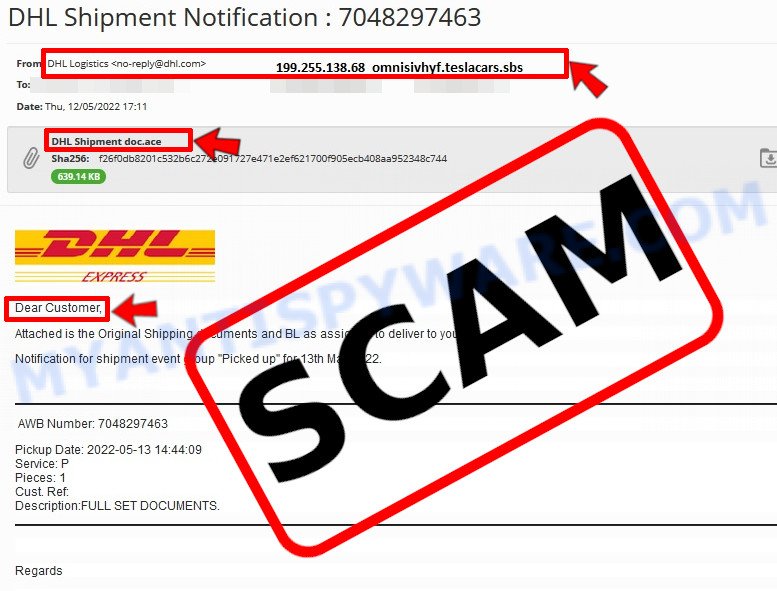
💡 Here Are Some Ways to Recognize a Phishing Email
- ✉️ Inconsistencies in Email Addresses: The most obvious way to spot a scam email is by finding inconsistencies in email addresses and domain names. If the email claims to be from a reputable company, like Amazon or PayPal, but is sent from a public email domain such as “gmail.com”, it’s probably a scam.
- 🔠 Misspelled Domain Names: Look carefully for any subtle misspellings in the domain name, such as “arnazon.com” where the “m” is replaced by “rn,” or “paypa1.com,” where the “l” is replaced by “1.” These are common tricks used by scammers.
- 👋 Generic Greetings: If the email starts with a generic “Dear Customer”, “Dear Sir”, or “Dear Madam”, it may not be from your actual shopping site or bank.
- 🔗 Suspicious Links: If you suspect an email may be a scam, do not click on any links. Instead, hover over the link without clicking to see the actual URL in a small popup. This works for both image links and text links.
- 📎 Unexpected Attachments: Email attachments should always be verified before opening. Scan any attachments for viruses, especially if they have unfamiliar extensions or are commonly associated with malware (e.g., .zip, .exe, .scr).
- ⏰ Sense of Urgency: Creating a false sense of urgency is a common tactic in phishing emails. Be wary of emails that claim you must act immediately by calling, opening an attachment, or clicking a link.
- 📝 Spelling and Grammar Errors: Many phishing emails contain spelling mistakes or grammatical errors. Professional companies usually proofread their communications carefully.
- 🔒 Requests for Sensitive Information: Legitimate organizations typically do not ask for sensitive information (like passwords or Social Security numbers) via email.
Conclusion
The ShinyHunters hacking group email is a fraudulent extortion attempt designed to frighten recipients into paying money under false pretenses. The scammers rely on fear, invasion of privacy claims, and urgent threats to manipulate victims, falsely asserting they have hacked devices and obtained compromising videos or data.
This scam uses generic information and intimidation tactics, such as alleging unauthorized access to microphones, cameras, and private data, but provides no evidence of actual hacking or specific victim details. The demand for payment in cryptocurrency (Litecoin) is a common red flag in extortion scams because it is difficult to trace and recover.
Bottom Line: Do not respond to these emails or send any money. There is no legitimate verification or proof behind these threats. Instead, mark the message as spam, update your device security by running reputable antivirus and malware scans, and change your passwords using strong, unique combinations. If you feel threatened or compromised, consider consulting cybersecurity professionals or law enforcement.