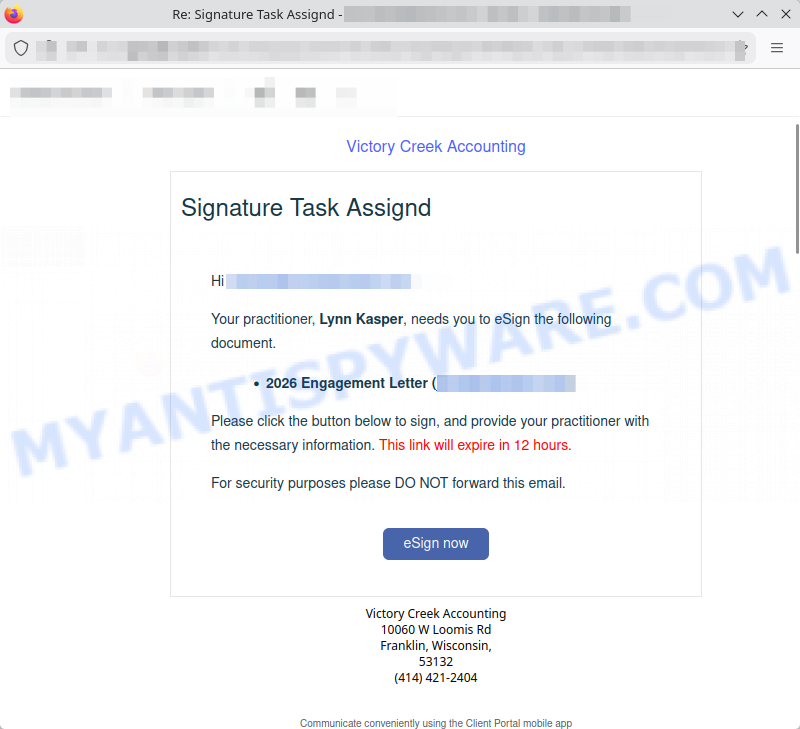
Beware of the “Signature Task Assignd” email scam — a cunning phishing attempt disguised as a routine document signing request. Posing as Victory Creek Accounting’s HR department, the email urges recipients to eSign a supposedly important “2026 Engagement Letter” via a clickable link that expires in 12 hours. But here’s the catch: that “eSign now” button doesn’t lead to any secure client portal. Instead, it directs you to a fraudulent website designed to steal your sensitive information.
This scam preys on the urgency and familiarity of workplace communications, tricking users into handing over data under the guise of professional necessity. The email’s convincing details — a real-looking company address, phone number, and a push to download mobile apps — only add to the illusion of legitimacy. In truth, responding or clicking any links in this message risks exposing your credentials to cybercriminals. Stay alert, verify unexpected requests through official channels, and never click links from suspicious emails. Your digital security depends on it.
A typical “Signature Task Assignd” scam email reads as follows:
Re: Signature Task Assignd
From: Accounting Creek HRSignature Task Assignd
Your practitioner, Lynn Kasper, needs you to eSign the following document.
2026 Engagement Letter (xxxxxx.xx)
Please click the button below to sign, and provide your practitioner with the necessary information. This link will expire in 12 hours.
For security purposes please DO NOT forward this email.
eSign now
Victory Creek Accounting
10060 W Loomis Rd
Franklin, Wisconsin, 53132
(414) 421-2404
Communicate conveniently using the Client Portal mobile app
Get it on the App Store Get it on Google Play
Questions? Reach out to us through the client portal or using the contact information above.
This inbox is unmonitored and replies may not be seen or responded to.
🕵️♂️ How the Signature Task Assignd Email Scam Operates
Signature Task Assignd is a fraudulent phishing email scam. 🚨 It tricks recipients into clicking malicious links disguised as legitimate document signature requests to steal their personal or financial information. 🔗 Step-by-Step Breakdown of the Scam:
📧 Sending Deceptive Emails
Scammers send emails that appear to come from reputable companies, such as “Accounting Creek HR,” using subject lines like “Signature Task Assignd” to create urgency and prompt immediate action. These emails often claim you need to eSign an important document related to your practitioner or engagement.
🔗 Including Fake Signature Links
The emails contain a prominent “eSign now” button that directs victims to a phishing website. This site looks professional and mimics legitimate client portals but is designed to capture login credentials, personal data, or financial information.
🕵️♂️ Creating a Sense of Urgency
The message warns that the signing link will expire in a limited time (e.g., 12 hours), pressuring recipients to act quickly without verifying the email’s authenticity.
📞 Falsely Claiming Security and Trustworthiness
The email includes company contact details, addresses, and disclaimers (such as “For security purposes please DO NOT forward this email”) to appear credible and trustworthy.
⚠️ Using Unmonitored Sender Addresses
The “From” address and reply information often indicate the inbox is unmonitored, discouraging replies or questions that might expose the scam.
💔 Harvesting Sensitive Information
When victims click the “eSign now” button and interact with the phishing site, their sensitive data (login credentials, signatures, or payment details) are harvested for identity theft or financial fraud.
In summary, the Signature Task Assignd email scam deceives recipients by impersonating legitimate accounting or HR departments and urging them to eSign fake documents via phishing links. The scammers use urgency, credible-looking emails, and fake contact details to trick individuals into divulging sensitive information. To protect yourself, avoid clicking on suspicious links, verify requests directly with your service providers, and be cautious with unexpected emails demanding urgent action.
📧 What to Do When You Receive the “Signature Task Assignd” Scam Email
We advise everyone who receives this email to follow the simple steps below to protect yourself from potential scams:
- ❌ Do not believe this email.
- 🔒 NEVER share your personal information and login credentials.
- 📎 Do not open unverified email attachments.
- 🚫 If there’s a link in the scam email, do not click it.
- 🔍 Do not enter your login credentials before examining the URL.
- 📣 Report the scam email to the FTC at www.ftc.gov.
If you accidentally click a phishing link or button in the “Signature Task Assignd” Email, suspect that your computer is infected with malware, or simply want to scan your computer for threats, use one of the free malware removal tools. Additionally, consider taking the following steps:
- 🔑 Change your passwords: Update passwords for your email, banking, and other important accounts.
- 🛡️ Enable two-factor authentication (2FA): Add an extra layer of security to your accounts.
- 📞 Contact your financial institutions: Inform them of any suspicious activity.
- 🔄 Monitor your accounts: Keep an eye on your bank statements and credit reports for any unusual activity.
🔍 How to Spot a Phishing Email
Phishing emails often share common characteristics; they are designed to trick victims into clicking on a phishing link or opening a malicious attachment. By recognizing these signs, you can detect phishing emails and prevent identity theft:
💡 Here Are Some Ways to Recognize a Phishing Email
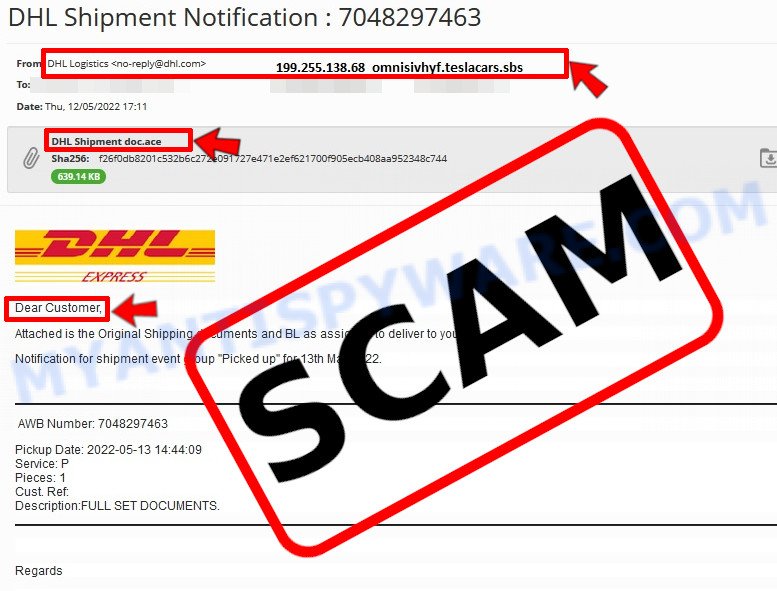
- ✉️ Inconsistencies in Email Addresses: The most obvious way to spot a scam email is by finding inconsistencies in email addresses and domain names. If the email claims to be from a reputable company, like Amazon or PayPal, but is sent from a public email domain such as “gmail.com”, it’s probably a scam.
- 🔠 Misspelled Domain Names: Look carefully for any subtle misspellings in the domain name, such as “arnazon.com” where the “m” is replaced by “rn,” or “paypa1.com,” where the “l” is replaced by “1.” These are common tricks used by scammers.
- 👋 Generic Greetings: If the email starts with a generic “Dear Customer”, “Dear Sir”, or “Dear Madam”, it may not be from your actual shopping site or bank.
- 🔗 Suspicious Links: If you suspect an email may be a scam, do not click on any links. Instead, hover over the link without clicking to see the actual URL in a small popup. This works for both image links and text links.
- 📎 Unexpected Attachments: Email attachments should always be verified before opening. Scan any attachments for viruses, especially if they have unfamiliar extensions or are commonly associated with malware (e.g., .zip, .exe, .scr).
- ⏰ Sense of Urgency: Creating a false sense of urgency is a common tactic in phishing emails. Be wary of emails that claim you must act immediately by calling, opening an attachment, or clicking a link.
- 📝 Spelling and Grammar Errors: Many phishing emails contain spelling mistakes or grammatical errors. Professional companies usually proofread their communications carefully.
- 🔒 Requests for Sensitive Information: Legitimate organizations typically do not ask for sensitive information (like passwords or Social Security numbers) via email.
Conclusion
The Signature Task Assignd email is a phishing scam, designed to trick you into clicking a malicious link under the guise of an urgent document signature request. The scammers impersonate a legitimate accounting firm, Victory Creek Accounting, using a fake sender address and professional-looking email templates to gain your trust.
This deceitful message contains a link labeled “eSign now” which leads to a phishing website aiming to steal your personal information or login credentials. The email uses urgency tactics like a 12-hour expiration to pressure recipients into quick action without proper verification.
Bottom Line: Do not click any links or download attachments from unexpected emails requesting signatures or personal details. Always verify the sender’s identity through trusted channels. If you receive a similar email, contact the company directly using official contact information—not the details provided in the suspicious email.