DHL Delivery Notice of Arrival Email Scam is a classic example of phishing attacks targeting unsuspecting recipients by mimicking real courier communications. Claiming your package has arrived and asking you to “Approve” documents, these emails trick users into clicking links that lead to fraudulent websites designed to steal personal data.

At first glance, the message looks official—complete with shipment numbers, flight details, and attached documents named to sound legitimate. But the slick presentation hides malicious intent: the “Approve” button doesn’t confirm your delivery; it opens a phishing site that could compromise your security.
This scam preys on the urgency and trust associated with parcel deliveries, exploiting DHL’s reputation to bait victims. The key takeaway? Real delivery companies don’t ask you to approve shipments via email links. Recognizing these red flags is critical to avoid falling victim to identity theft or worse. Stay alert and verify delivery requests directly through official courier websites or customer support channels.
A typical “DHL Delivery Notice of Arrival” scam email reads as follows:
NOTICE OF ARRIVAL
From: DHL DELIVERYNOTICE OF ARRIVAL (NOA)
Dear Valued Customer,Kindly be advised that your consignment has arrived at Airport, through DHL Express, and the consignment transportation references are as follows:
MAWB NO.: 11901387433 DHL HAWB NO.: 2956728703
FLIGHT NO: 8K713 DATE: 09 2025Attached are the documents required for initiating the clearance process:
• Notice of Arrival
• AWB, Invoice, and other consignment related documents
• Copy of Manifest
• Copy of MAWB
• Customer Advance FormWe are looking forward to your approval to enable us in clarification please click on approve to
DTP -Kindly click approve for clarificationApprove
CONFIDENTIALITY NOTICE: This message is from DHL and may contain confidential business information. It is intended solely for the use of the individual to whom it is addressed. If you are not the intended recipient please contact the sender and delete this message and any attachment from your system. Unauthorized publication, use, dissemination, forwarding, printing or copying of this E-Mail and its attachments is strictly prohibited.
🕵️♂️ How the DHL Delivery Notice Email Scam Operates
The DHL Delivery Notice Email is a phishing attack. 🚨 It tricks recipients into clicking malicious links by pretending to be an official DHL shipment notification. 🔗 Step-by-Step Breakdown of the Scam:
📧 Sending Fake DHL Emails
Scammers send emails that appear to be from DHL, with subject lines like “NOTICE OF ARRIVAL” and sender names such as “DHL DELIVERY”. These emails claim a package has arrived and requires your immediate attention to proceed with customs clearance.
📎 Including Fraudulent Attachments
The emails contain attachments or links labeled as important shipping documents (Notice of Arrival, AWB, Invoice, Manifest, MAWB, Customer Advance Form). These documents are fake and are designed to make the message look official.
🔗 Phishing Link to Fake Website
The email urges you to click an “Approve” button or link to authorize the shipment clearance. This button redirects you to a phishing website made to look like a legitimate DHL page aimed at stealing your personal information, login credentials, or payment details.
⚠️ Using Urgency and Authority
The message uses authoritative language, references to flights, airway bills, and dates to create a sense of urgency, pressuring recipients to act without verifying the email’s authenticity.
🕵️♀️ Hiding Malicious Intent
The email often mimics DHL’s confidentiality notice to appear genuine and trustworthy, discouraging recipients from sharing or questioning the message.
🚫 No Real Package or DHL Contact
There is no actual shipment associated with the recipient, and the contact information provided in these fake emails is usually invalid or leads to scammer-controlled addresses.
❌ Consequences of Clicking the Link
By clicking “Approve,” users risk exposing sensitive information to criminals, which can lead to identity theft, financial loss, or unauthorized access to personal or corporate data.
In summary, the DHL Delivery Notice Email Scam deceives victims by impersonating DHL shipment notifications. The scam uses fake emails, fraudulent documents, and phishing links with urgent language to trick users into giving away personal and financial information. Stay alert and verify any unexpected delivery notices directly with official courier services to avoid falling victim to this scam.
📧 What to Do When You Receive the “DHL Delivery Notice of Arrival” Scam Email
We advise everyone who receives this email to follow the simple steps below to protect yourself from potential scams:
- ❌ Do not believe this email.
- 🔒 NEVER share your personal information and login credentials.
- 📎 Do not open unverified email attachments.
- 🚫 If there’s a link in the scam email, do not click it.
- 🔍 Do not enter your login credentials before examining the URL.
- 📣 Report the scam email to the FTC at www.ftc.gov.
If you accidentally click a phishing link or button in the “DHL Delivery Notice of Arrival” Email, suspect that your computer is infected with malware, or simply want to scan your computer for threats, use one of the free malware removal tools. Additionally, consider taking the following steps:
- 🔑 Change your passwords: Update passwords for your email, banking, and other important accounts.
- 🛡️ Enable two-factor authentication (2FA): Add an extra layer of security to your accounts.
- 📞 Contact your financial institutions: Inform them of any suspicious activity.
- 🔄 Monitor your accounts: Keep an eye on your bank statements and credit reports for any unusual activity.
🔍 How to Spot a Phishing Email
Phishing emails often share common characteristics; they are designed to trick victims into clicking on a phishing link or opening a malicious attachment. By recognizing these signs, you can detect phishing emails and prevent identity theft:
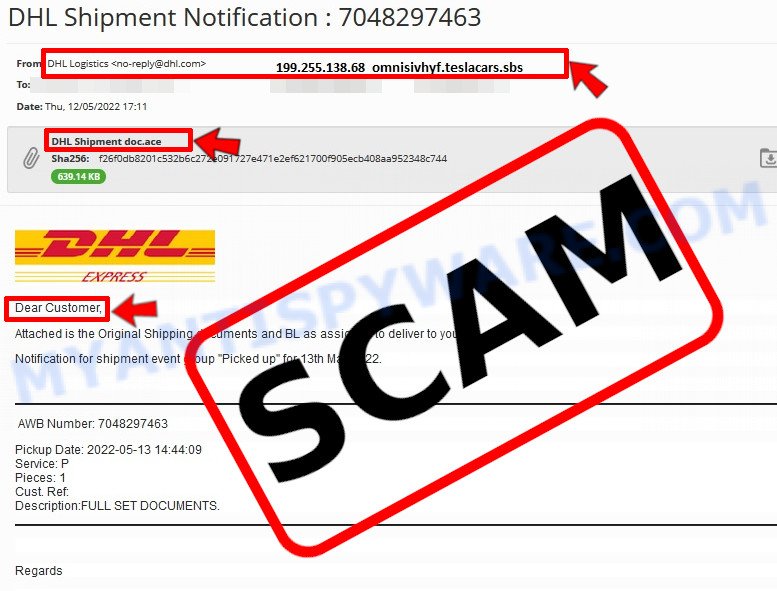
💡 Here Are Some Ways to Recognize a Phishing Email
- ✉️ Inconsistencies in Email Addresses: The most obvious way to spot a scam email is by finding inconsistencies in email addresses and domain names. If the email claims to be from a reputable company, like Amazon or PayPal, but is sent from a public email domain such as “gmail.com”, it’s probably a scam.
- 🔠 Misspelled Domain Names: Look carefully for any subtle misspellings in the domain name, such as “arnazon.com” where the “m” is replaced by “rn,” or “paypa1.com,” where the “l” is replaced by “1.” These are common tricks used by scammers.
- 👋 Generic Greetings: If the email starts with a generic “Dear Customer”, “Dear Sir”, or “Dear Madam”, it may not be from your actual shopping site or bank.
- 🔗 Suspicious Links: If you suspect an email may be a scam, do not click on any links. Instead, hover over the link without clicking to see the actual URL in a small popup. This works for both image links and text links.
- 📎 Unexpected Attachments: Email attachments should always be verified before opening. Scan any attachments for viruses, especially if they have unfamiliar extensions or are commonly associated with malware (e.g., .zip, .exe, .scr).
- ⏰ Sense of Urgency: Creating a false sense of urgency is a common tactic in phishing emails. Be wary of emails that claim you must act immediately by calling, opening an attachment, or clicking a link.
- 📝 Spelling and Grammar Errors: Many phishing emails contain spelling mistakes or grammatical errors. Professional companies usually proofread their communications carefully.
- 🔒 Requests for Sensitive Information: Legitimate organizations typically do not ask for sensitive information (like passwords or Social Security numbers) via email.
Conclusion
The DHL Delivery Notice of Arrival Email is a scam, designed to trick recipients with fake notifications and fraudulent attachments. This phishing email uses official-sounding language, shipping references, and supposed consignment details to create a sense of urgency and legitimacy, prompting recipients to click on malicious links under the guise of approving delivery clearance.
In reality, clicking the “Approve” button directs to a phishing site intended to steal personal information, login credentials, or financial details. The email falsely claims to be from DHL and attempts to exploit trust in a well-known shipping company, but it contains red flags such as generic greetings, unexpected attachments, and unsolicited requests.
Bottom Line: Avoid interacting with unsolicited DHL delivery emails asking for approval or personal information. Always verify shipment details directly on the official DHL website using your tracking number, and never click links or open attachments from suspicious or unexpected emails. Stay vigilant to protect yourself from phishing scams masked as legitimate delivery notifications.