MemoHoney is a memory-boosting supplement linked to a so-called “cinnamon and honey ritual” that supposedly reverses Alzheimer’s disease in just 45 days. But a deep dive into its shady online sales funnel reveals a web of deception: fake news site mimicry, bogus endorsements featuring Bill Gates, and unverifiable miracle claims. The entire setup is designed to rush consumers into buying capsules without a shred of credible scientific proof or legitimate medical backing.
At its core, MemoHoney’s pitch relies on a smoke-and-mirrors approach—using cloned CNN logos, fabricated testimonials, and invented clinical trials that never happened. The product’s legitimacy is further undermined by suspicious “stock” counters, endless pressure via countdown timers that don’t actually count down, and promises of “FDA Approved” badges with zero confirmation. Worse yet, the checkout process collects sensitive personal and payment info while masquerading security seals that don’t guarantee your data—or your health—is safe.
If you’re thinking about MemoHoney, think twice. “Cinnamon and Honey Ritual” is a textbook health scam built on false associations and unsupported claims exploiting fears around Alzheimer’s. The only ritual here is the one pulling your wallet dry. Your best defense? Ignore these slick marketing tricks and stick to verified medical advice from trusted healthcare professionals.
💡 Heads-up: Similar Scams Are Everywhere. MemoHoney is not unique. It is one of many fake supplements, gadgets, and other schemes we expose in our Fact Checks section. All of them aim to grab your personal data or money. The people behind these scams run slick websites, spread bogus promo codes, and even pose as trusted brands or experts. Below are a few recent scams that follow the same playbook as MemoHoney: Rev750Wmart.com, Glyco Ultra, GlucoDefense7, Hunnylink.com, Nerve Flow.

Table of Contents
🚨 Is MemoHoney a Scam?
MemoHoney is promoted as a dietary supplement featuring a “cinnamon and honey ritual” that allegedly supports memory and reverses Alzheimer’s disease in 45 days without drugs or injections. However, extensive evidence indicates that MemoHoney is part of a deceptive marketing scam designed to lure consumers with false claims and fabricated endorsements.
Key Red Flags:
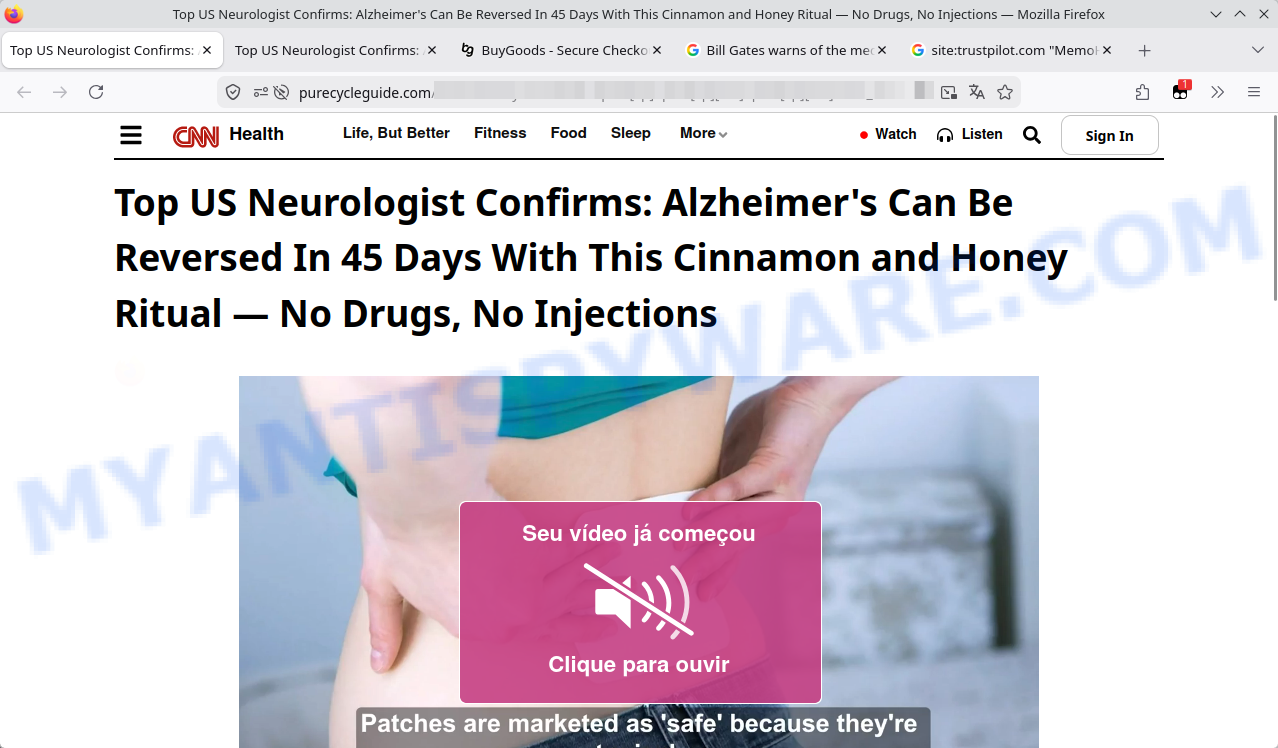
- 🌐 Fake News Page: The landing page mimics CNN Health branding but is hosted on
purecycleguide.com, a domain unrelated to CNN. This impersonation aims to create false credibility for the product. - ❌ Unsupported Medical Claims: The site claims Alzheimer’s can be reversed in 45 days using the cinnamon and honey ritual, but no scientific studies, named neurologists, or verified medical sources support this. The promised ritual itself is never demonstrated or documented.
- 🎥 Incomplete and Misleading Video Presentation: The main video does not provide the claimed cinnamon-and-honey treatment. Instead, it ends with a sales pitch for MemoHoney capsules, with no credible medical information presented.
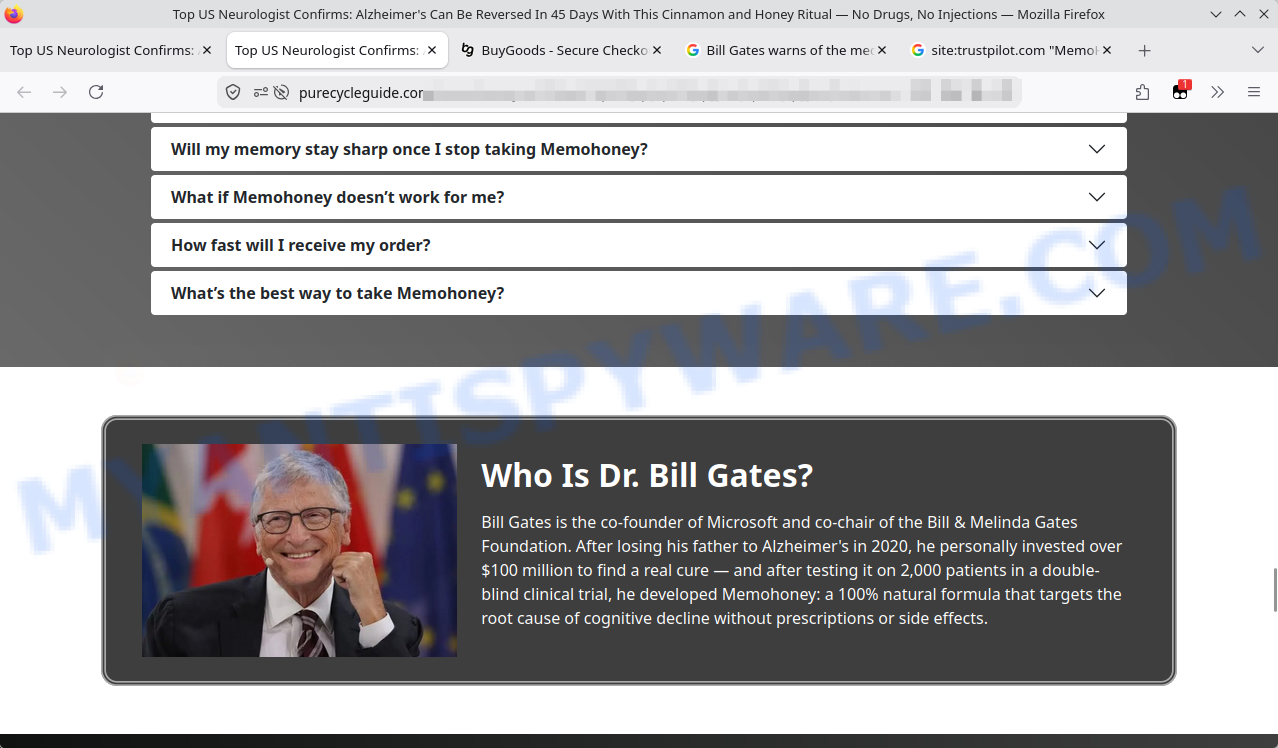
- 👤 False Endorsements and Testimonials: Testimonials and reviews praising MemoHoney and “Gates” are clearly fabricated and solely appear on seller-controlled pages. A “Dr. Bill Gates” (using Bill Gates’ image) is falsely credited with developing MemoHoney and investing over $100 million, without any verifiable proof.
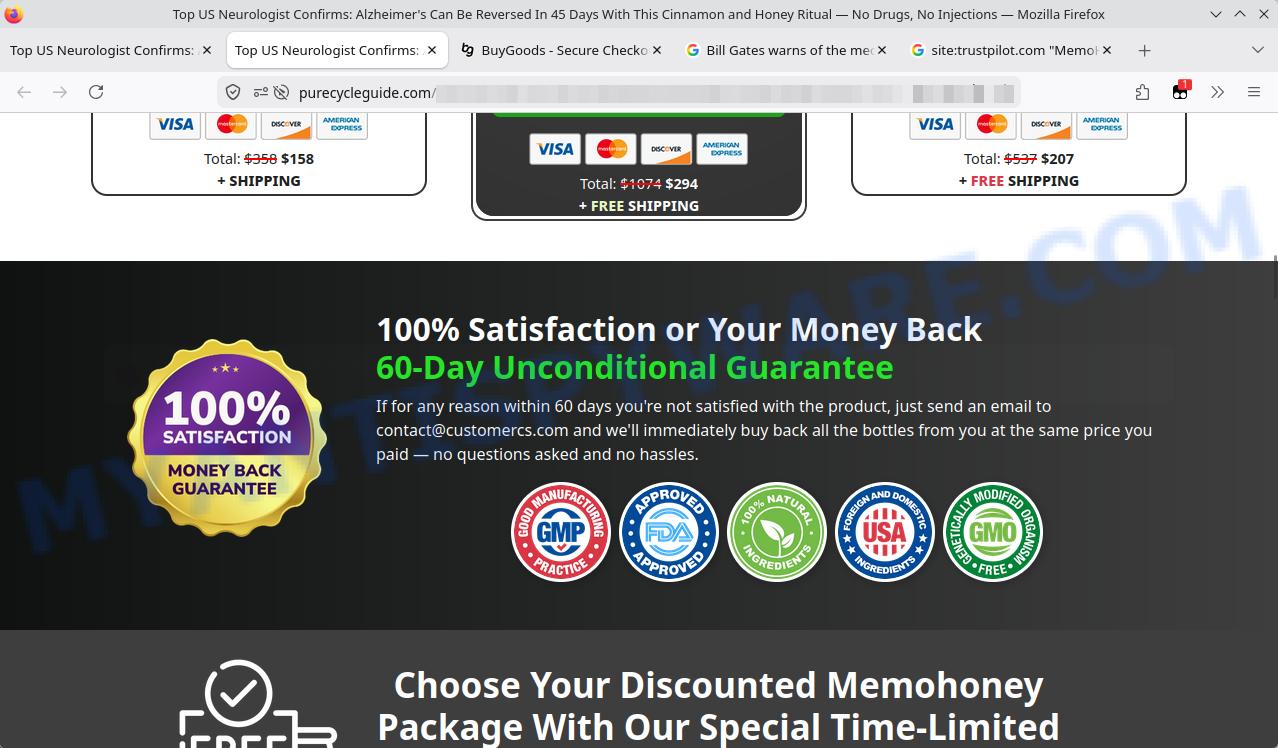
- 🎭 Fake Certification Badges: Claims of “FDA Approved,” “Good Manufacturing Practice,” “100% Natural,” and “GMO Free” badges are not substantiated by independent certification or official records.
- ⏳ Pressure Sales Tactics: The checkout features countdown timers with expired zero values, stock countdowns that change inexplicably, and “limited time” offers designed to rush buyers into impulsive purchases.
- 🔐 Questionable Payment and Customer Support: While branded “Secure Checkout,” the payment funnel collects extensive personal and payment data without providing physical company address details. Refund requests are routed to a generic email with no guarantee of fulfillment.
- 🚫 Fake Trust and Review Claims: The checkout page promotes thousands of positive reviews and “Live People Online” counters, but independent searches find no corroborating trust site reviews, suggesting the social proof is fabricated.
- ⚠️ Misleading Associations with Bill Gates and CNN: The use of Bill Gates’ image and CNN-style design falsely imply endorsements or involvement, misleading consumers about the product’s legitimacy.
In summary, MemoHoney’s marketing funnel is built on deceptive mimicry of trusted media, unsubstantiated claims about Alzheimer’s treatment, fabricated testimonials, and bogus endorsements falsely linked to Bill Gates. No independent medical evidence supports its promises, and the sales tactics used indicate a high risk to consumers both financially and in terms of personal data security. It is strongly advised to avoid MemoHoney and consult licensed healthcare professionals for legitimate cognitive health concerns.
🕵️♂️ How the Scam Operates
🚨 It falsely promises to reverse Alzheimer’s disease using a cinnamon-and-honey ritual, but it is just a marketing scheme designed to sell capsules with no scientific backing. 🔗 Step-by-Step Breakdown of the Scam:
🛒 Creating a Fake Health News Page
Scammers have built a fraudulent landing page, `purecycleguide.com`, designed to look like CNN Health. This fake news site falsely claims a top US neurologist confirmed that Alzheimer’s can be reversed in 45 days with a cinnamon-and-honey ritual — with zero evidence or named experts provided.
🎥 Misleading Video Presentation
A lengthy video plays on the page, purportedly explaining why certain medications should be avoided and hinting at a natural cure. However, the video never shows a verified cinnamon-and-honey procedure or medical proof. It ultimately transitions into a sales pitch for MemoHoney capsules.
👨⚕️ Fabricated Endorsements and False Credibility
The scam uses fake testimonials, including fake Facebook-style comments praising “Gates,” and fabricated five-star reviews from fictitious customers claiming impressive health results. They even falsely claim that Bill Gates coined the product, invested $100 million, and conducted large clinical trials — none of which are supported by any evidence.
🚩 Fake Certifications and Legal Claims
On the landing page and checkout, misleading seals such as “FDA Approved,” “GMP Certified,” and “100% Natural Ingredients” are displayed without any legitimate certification or proof. Customers are deceived into believing the product is safe, legal, and medically endorsed.
💰 High-Priced Package Deals with Fake Discounts
MemoHoney is offered in overpriced packages, with bogus slashed prices to simulate a discount. For example, two bottles marked down from $358 to $158 plus shipping, creating false urgency with fake timers and limited stock notices that reset or disappear unexpectedly.
In summary, the scam dupes consumers by imitating respected health media, fabricating endorsements (including a false link to Bill Gates), making unsupported medical claims, and pressuring purchases with fake discounts and urgency tactics. The product itself is ineffective, and buyer protections are minimal to nonexistent. This scam is a reminder to verify health product claims through trusted sources, avoid offers that rely on celebrity endorsements without proof, and be wary of online supplements promising miracle cures.
😱 What to Do If Scammed
If you find yourself ensnared by the MemoHoney Scam, immediate action is crucial. Here’s what you should consider doing:
🛑 Stop Further Transactions
The first step is to halt any additional transactions that might be in process. Contact your bank or credit card provider and inform them that you’ve fallen victim to a scam. They can help by blocking the card or reversing any unauthorized transactions.
📞 Report the Fraud
File a report with your local police and provide all the available evidence, such as screenshots, emails, and website URLs. Additionally, report the scam to online portals like the Better Business Bureau (BBB) at www.bbb.org or the Federal Trade Commission (FTC) at reportfraud.ftc.gov. If you’re in another country, reach out to your national consumer protection agency.
💻 Take Screenshots
Before the scam website gets taken down or changes, make sure to capture screenshots of your transactions and communications. These can serve as evidence if you decide to pursue legal action.
⚖️ Consult Legal Advice
Speak to a legal advisor about your situation. While pursuing legal action may be time-consuming and costly, it could be a possible avenue for recovering your lost money.
📢 Share Your Experience
Use social media platforms to share your experience and warn others about the scam. Your story could prevent someone else from falling victim to the same or similar scams.
Summary Table
| Factor | Observations | Impact on Legitimacy |
|---|---|---|
| Product Description | MemoHoney is advertised as a supplement for memory and brain support, claiming it can reverse Alzheimer’s disease in 45 days using a cinnamon and honey ritual. However, no actual details or proof of this ritual are provided, and the product is ultimately sold as capsules without medical evidence backing the health claims. | Negative (Unproven and misleading health claims) |
| Advertising and Landing Page | The sales page copies CNN Health’s design but is hosted on a fake domain, `purecycleguide.com`. It uses headlines and comments to falsely appear trustworthy. There is no clear information about the neurologist or source of the article, and the associated video does not fully explain the cinnamon and honey treatment. | Negative (Fake news-style page and misleading presentation) |
| Credibility and Endorsements | The site falsely claims support from Bill Gates, including a photo and statements about his investment and involvement. It also shows fake certifications like FDA approval and GMP compliance. None of these claims are supported by real evidence or independent verification. | Negative (False endorsements and fake certifications) |
| User Reviews and Comments | All reviews and comments praising MemoHoney are found only on the seller’s website and appear manufactured. No real customer feedback or independent reviews exist on trustworthy platforms like Trustpilot. | Negative (Fabricated testimonials and lack of real reviews) |
| Pricing and Sales Tactics | MemoHoney is offered in multi-bottle packages with large discounts and time-limited offers. Stock availability numbers and countdown timers are inconsistent and manipulated to create pressure on buyers. | Negative (Pressure selling and suspicious pricing tactics) |
| Payment and Security | Payment is processed through BuyGoods, which shows secure checkout badges, but no detailed information about the seller or refund history is provided. The refund process relies solely on contacting a generic email, with no physical address or proof of refund reliability. | Negative (Unclear seller identity and uncertain refund policy) |
| Risk to Consumers | Entering personal and payment information on this site carries risks because the seller is not transparent or verified. There is no assurance that buyers will get the product, refunds, or protection of their data. The medical claims may also mislead people with serious health concerns. | Negative (Personal data risks and potential financial loss) |
| Associations with Public Figures | The use of Bill Gates’ name and image, as well as a CNN-like layout, is a false attempt to appear credible. There is no real connection with Bill Gates, Microsoft, the Gates Foundation, or CNN. This tactic is common in scams using fake endorsements. | Negative (False and deceptive affiliations) |
Conclusion
The MemoHoney “Cinnamon and Honey Ritual” is a scam, built on deceptive marketing, fabricated testimonials, and false endorsements. This fraudulent scheme falsely claims to reverse Alzheimer’s disease in 45 days through a so-called cinnamon-and-honey ritual, but no credible evidence, scientific study, or legitimate medical support backs these assertions.
The promotional website shamelessly copies the CNN Health design and falsely uses Bill Gates’ name and image, alleging an unverified $100 million investment and clinical trials that never existed. The glowing reviews, urgent stock warnings, fake “FDA Approved” and “GMP Certified” badges, and a seemingly secure checkout are all crafted to mislead visitors into believing MemoHoney is a trustworthy, effective supplement.
Bottom Line: Avoid MemoHoney at all costs. The product’s claims are unsubstantiated, and the marketing tactics rely on forged credibility and false medical endorsements. Never trust any online offer that uses fake news-style pages, celebrity impersonations, or pressure sales with countdown timers and stock limitations.