Watch out for the latest FedEx Express Delivery Confirmation email scam sweeping inboxes. Claiming your package couldn’t be delivered due to an “incomplete physical address,” the email urges you to click an “Update address” button—only to redirect you to a phishing site designed to steal your personal information.
This scam cleverly mimics official FedEx branding and language, even including fake invoice numbers and copyright notices to seem legitimate. But don’t be fooled: the sender’s email address is suspicious, and the message’s urgent tone is a classic tactic to rush you into giving up sensitive data.
At its core, this bait-and-switch scam exploits your trust in shipping companies and your eagerness to receive packages. If you get a FedEx email like this, always verify directly on FedEx’s official website instead of clicking any links. Stay vigilant—these tricks prey on the smallest slip-up and can cost you big.
A typical “FedEx Express Delivery Confirmation” scam email reads as follows:
Subject: FedEx Express Delivery Confirmation (Invoice and AWB)
From: Fedex [email protected]FedEx [logo]
Dear [xxxxx],
We would like to inform you that your package could not be delivered due to incomplete information of your physical address.
Please use the button below to update your personal address .
Update addressThis email has been sent to contact@[xxxx].com
2021 FedEx. The content of this message is protected by copyright and trademark laws under U.S. and international law. Review our privacy policy. All rights reserved.
10035219-3-6-US-EN-30234263
🕵️♂️ How the FedEx Express Delivery Confirmation Email Scam Operates
The FedEx Express Delivery Confirmation Email Scam is a phishing fraud. 🚨 It tricks recipients into clicking malicious links by pretending to be a legitimate FedEx delivery notification, aiming to steal personal information. 🔗 Step-by-Step Breakdown of the Scam:

📧 Sending Fake Delivery Emails
Scammers send emails claiming to be from FedEx, with subjects like “FedEx Express Delivery Confirmation (Invoice and AWB)”. These emails inform recipients that their package could not be delivered due to incomplete address details.
🕸️ Creating Phishing Websites
The emails contain a button labeled “Update address” that directs users to fraudulent websites designed to capture sensitive personal information, such as full address, contact details, and sometimes payment data.
📢 Imitating Official Branding
The scam emails mimic FedEx’s branding by including logos, legal disclaimers, and copyright notices to appear authentic and convince recipients to trust the message.
⚠️ Exploiting Urgency and Fear
The message uses urgent language warning that your package cannot be delivered, pressuring recipients to act quickly without verifying the email’s legitimacy.
🔎 Using Generic and Spoofed Email Addresses
The sender’s email often appears suspicious or unrelated to the official FedEx domain (e.g., [email protected]), and recipients’ email address may be used in the greeting or email body to increase the email’s credibility.
💻 Harvesting Personal Data
Once victims click the link and input their details on the phishing site, scammers gain access to personal and confidential information, which can be used for identity theft or further fraud.
In summary, the FedEx Express Delivery Confirmation Email Scam deceives people by posing as an important delivery notice. The scammers use fake emails, spoofed branding, and phishing websites to steal personal information. Recipients should be cautious, verify email sources, avoid clicking suspicious links, and directly visit official FedEx websites or contact their customer service to confirm package status.
📧 What to Do When You Receive the “FedEx Express Delivery Confirmation” Scam Email
We advise everyone who receives this email to follow the simple steps below to protect yourself from potential scams:
- ❌ Do not believe this email.
- 🔒 NEVER share your personal information and login credentials.
- 📎 Do not open unverified email attachments.
- 🚫 If there’s a link in the scam email, do not click it.
- 🔍 Do not enter your login credentials before examining the URL.
- 📣 Report the scam email to the FTC at www.ftc.gov.
If you accidentally click a phishing link or button in the “FedEx Express Delivery Confirmation” Email, suspect that your computer is infected with malware, or simply want to scan your computer for threats, use one of the free malware removal tools. Additionally, consider taking the following steps:
- 🔑 Change your passwords: Update passwords for your email, banking, and other important accounts.
- 🛡️ Enable two-factor authentication (2FA): Add an extra layer of security to your accounts.
- 📞 Contact your financial institutions: Inform them of any suspicious activity.
- 🔄 Monitor your accounts: Keep an eye on your bank statements and credit reports for any unusual activity.
🔍 How to Spot a Phishing Email
Phishing emails often share common characteristics; they are designed to trick victims into clicking on a phishing link or opening a malicious attachment. By recognizing these signs, you can detect phishing emails and prevent identity theft:
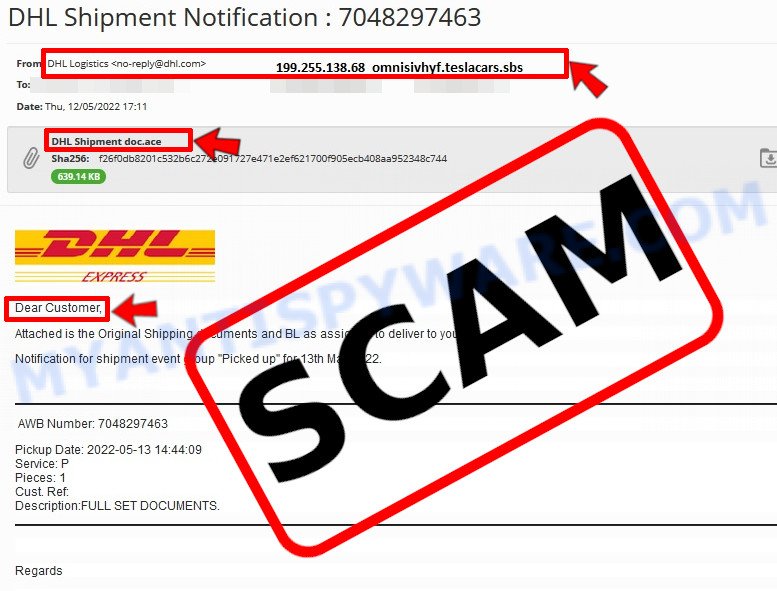
💡 Here Are Some Ways to Recognize a Phishing Email
- ✉️ Inconsistencies in Email Addresses: The most obvious way to spot a scam email is by finding inconsistencies in email addresses and domain names. If the email claims to be from a reputable company, like Amazon or PayPal, but is sent from a public email domain such as “gmail.com”, it’s probably a scam.
- 🔠 Misspelled Domain Names: Look carefully for any subtle misspellings in the domain name, such as “arnazon.com” where the “m” is replaced by “rn,” or “paypa1.com,” where the “l” is replaced by “1.” These are common tricks used by scammers.
- 👋 Generic Greetings: If the email starts with a generic “Dear Customer”, “Dear Sir”, or “Dear Madam”, it may not be from your actual shopping site or bank.
- 🔗 Suspicious Links: If you suspect an email may be a scam, do not click on any links. Instead, hover over the link without clicking to see the actual URL in a small popup. This works for both image links and text links.
- 📎 Unexpected Attachments: Email attachments should always be verified before opening. Scan any attachments for viruses, especially if they have unfamiliar extensions or are commonly associated with malware (e.g., .zip, .exe, .scr).
- ⏰ Sense of Urgency: Creating a false sense of urgency is a common tactic in phishing emails. Be wary of emails that claim you must act immediately by calling, opening an attachment, or clicking a link.
- 📝 Spelling and Grammar Errors: Many phishing emails contain spelling mistakes or grammatical errors. Professional companies usually proofread their communications carefully.
- 🔒 Requests for Sensitive Information: Legitimate organizations typically do not ask for sensitive information (like passwords or Social Security numbers) via email.
Conclusion
The FedEx Express Delivery Confirmation Email is a deceptive phishing attempt designed to steal your personal information by mimicking an official FedEx notification. Scammers use fake emails that appear legitimate, complete with FedEx logos and urgent language, to trick recipients into clicking malicious links labeled “Update address.” These links lead to phishing websites where your sensitive details, such as your physical address and potentially payment information, can be harvested.
The fraudulent email misleads recipients by claiming that a package could not be delivered due to incomplete address details and urges immediate action. However, no package issues exist, and the request is entirely fabricated. Unlike genuine FedEx communications, these scam emails often come from suspicious email addresses not associated with FedEx, and the embedded links direct users to unsafe, malicious websites.
Bottom Line: Do not click any links or provide any personal information if you receive an unsolicited FedEx delivery email that asks you to update your address. Always verify delivery issues by directly visiting the official FedEx website or contacting FedEx customer service. Stay vigilant, as phishing emails like this are increasingly sophisticated and exploit trust in well-known companies to steal your information. If you suspect an email is fraudulent, delete it immediately and report it to FedEx and your email provider.